Pair Match Games: Flashcards on Steroids (and Why Almost No One Uses Them)
A matching game is many acts of active recall stacked into one round — faster and more fun than flipping cards one at a time. Here's where pair match beats flashcards, where it doesn't, and how to split your material between them.
I'll be honest: I've always enjoyed pair match games more than flipping through flashcards one by one. Same content, same goal, but one feels like a chore and the other feels like play. And after building and using MugUp for a while, I've come to believe pair match games are one of the most underrated and underutilised tools in learning.
Here's the thing — a pair match game is essentially flashcards on steroids. Every match you make is an act of active recall: you see a term on one side, and your brain has to hunt for its counterpart. But unlike a regular flashcard session, you're doing many retrievals at once, with instant feedback every time you get a pair right or wrong. That little jolt of "yes, got it" is what keeps you going for one more round, and one more round is exactly what your memory needs.
Why matching feels different from flipping
A flashcard is one retrieval at a time, and you're the judge of whether you got it. That's a lot of small decisions, and it's easy to drift into "yeah, I knew that" without really having known it.
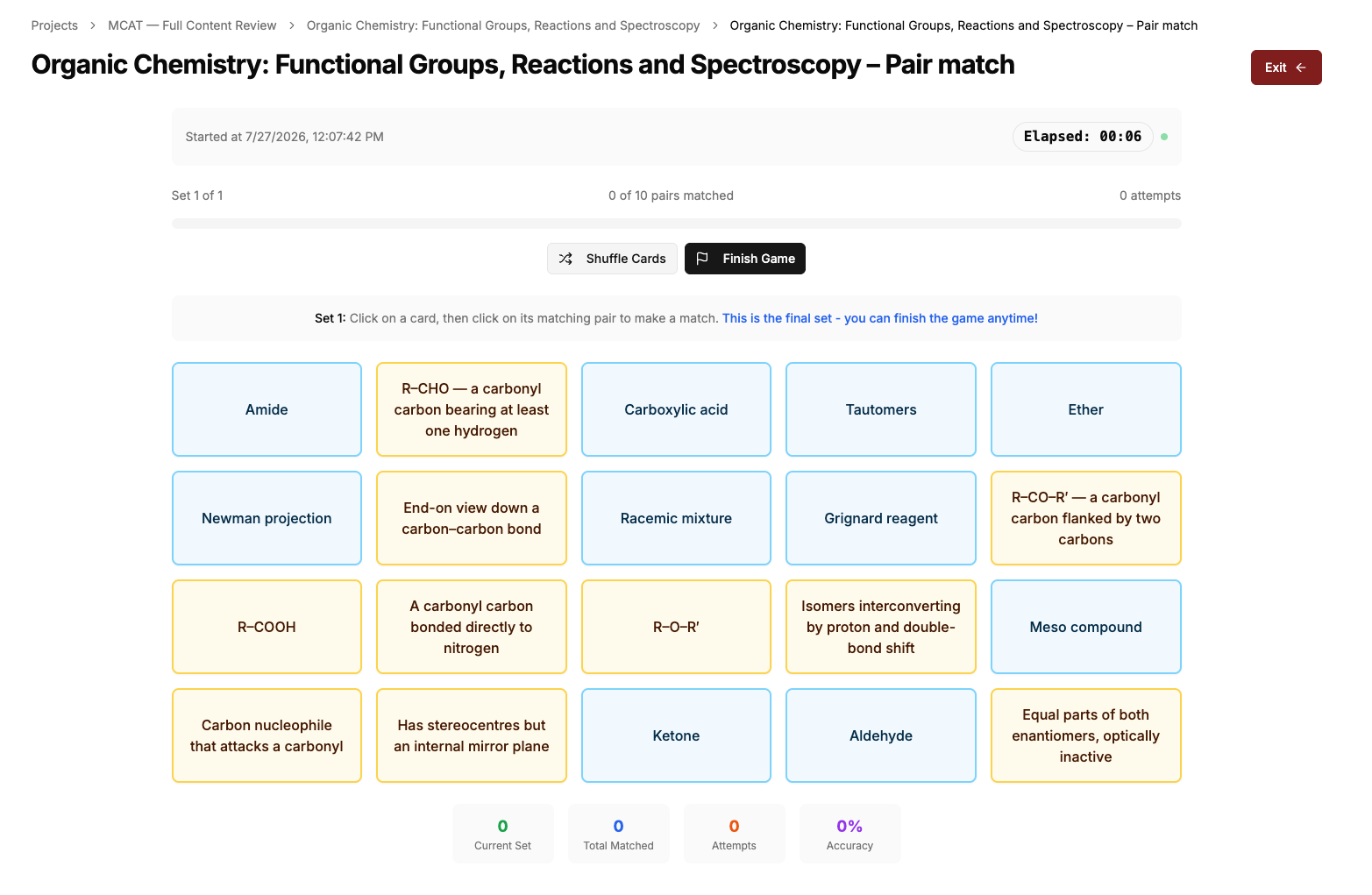
A matching round changes the shape of the task. Ten pairs land on the screen at once, and every card you click is a commitment. You can't wave a card away as "close enough" — either it pairs or it doesn't, and you find out immediately. The board also does something a flashcard can't: it puts related items side by side, so you're not just recalling amide, you're separating it from ketone and aldehyde sitting three cards over. Telling similar things apart is usually the actual hard part of a definitions-heavy subject.
That juxtaposition looks like a UI detail, but it may be the whole point. Birnbaum and colleagues set out to explain why mixing categories together beats studying them one block at a time, and the answer that held up was discrimination: seeing different categories close together lets you notice what separates them, which studying them in isolation never asks you to do. A flashcard deck shows you one card at a time by design. A matching board shows you the confusable ones together, and makes you commit to which is which.
There's a clock in the corner, but it's counting up, not down. Nothing forces you to hurry — it's there if you want to race your last run, and easy to ignore if you don't. Same with the accuracy and attempts counters underneath: a light score to beat rather than a punishment for thinking.
The limitation, stated plainly
I won't oversell it. Pair match has a real constraint: you can't fit much detail on a card. Each side has to stay short enough to scan at a glance, because you're reading ten of them at once. If your material needs long explanations, worked examples, or nuance, a plain flashcard — or a proper study session with the textbook open — is the better tool.
So pair match shines in a narrower lane than flashcards do. But in that lane, it works wonders.
The lane where it wins
That lane is definitions, terms, and vocabulary — anything where one short thing maps to another short thing:
- Term ↔ meaning. Functional groups and what they are, legal terms and their definitions, protocols and what they do.
- Word ↔ translation. The single best use of matching there is. If you're grinding vocabulary for JLPT N5 or a French exam, this beats flipping cards.
- Name ↔ what it stands for. Acronyms, drug names and their class, reactions and their reagents.
- Cause ↔ effect, event ↔ date. Anything that pairs cleanly and short.
For that kind of material, matching is faster, more engaging, and honestly just more fun than any other drill I've tried. And fun matters more than we admit: the best study method is the one you'll actually come back to tomorrow.
How it works in MugUp
Point MugUp at a definition-heavy chunk of your material and it generates the pairs for you — you don't sit there writing both sides of fifty cards. A round deals ten pairs at a time; click a card, click its match, and the board tells you straight away.
The pairs aren't dealt at random, either. Every pair you've played carries its own review history, so a round leads with what you've never seen and what you got wrong or are due to forget, and only then fills in with the ones you know cold. The game feels casual. The selection underneath it isn't.
Start free and turn your terms list into a board you can play in two minutes.
The takeaway
Don't treat pair match as a gimmick or a kids' game. Take the definition-heavy chunk of whatever you're learning, turn it into pairs, and play a few rounds a day. Save the deep flashcards for the concepts that need depth. Use each tool for what it's best at — and let the fun one carry the boring-but-essential memorisation work.
More on making study stick: why quizzing yourself helps you remember more and what Duolingo gets right about coming back every day.
Sources
- Birnbaum, M. S., Kornell, N., Bjork, E. L., & Bjork, R. A. (2013). Why interleaving enhances inductive learning: The roles of discrimination and retrieval. Memory & Cognition.
- Kornell, N., & Bjork, R. A. (2008). Learning Concepts and Categories: Is Spacing the "Enemy of Induction"? Psychological Science.
- Roediger, H. L., & Karpicke, J. D. (2006). Test-Enhanced Learning: Taking Memory Tests Improves Long-Term Retention. Psychological Science.
Turn this into a game
Type a topic and MugUp's AI builds quizzes, flashcards, and matching games in seconds. Free to start.